
Soil Testing for Construction in Jeddah: What Does the Report Reveal and How Does It Affect Foundation Design?
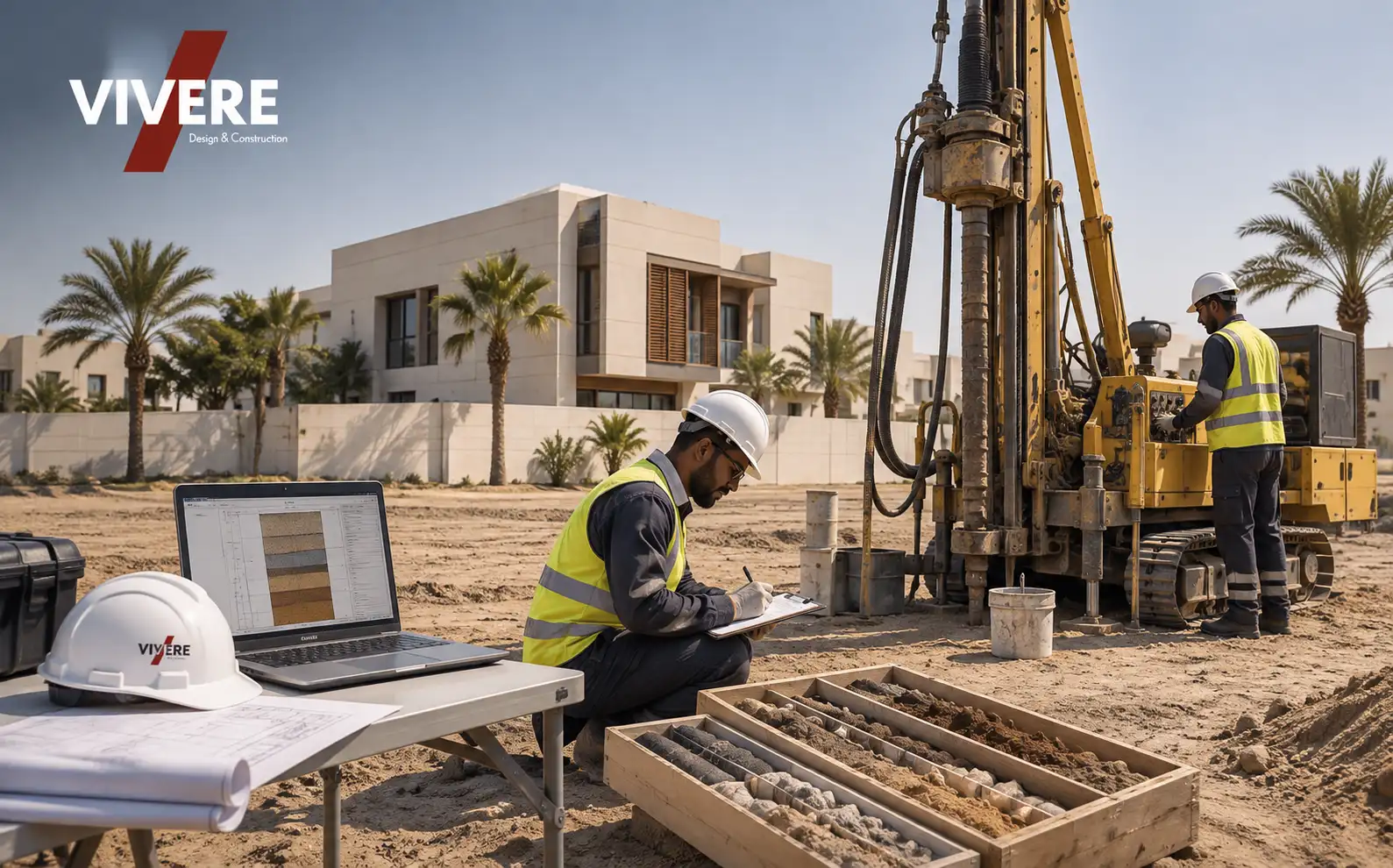
Before starting the construction of a villa or residential building, many property owners focus on architectural design, room layouts, and exterior finishes. However, there is an important engineering step that should take place before the final structural foundation design is approved: soil testing before construction.
The soil is the ground medium that receives the building loads through its foundations. Its properties can vary significantly from one plot to another, even within the same area. For this reason, the foundation type and dimensions should not be selected based only on the villa's size and number of floors without investigating the actual ground conditions.
Soil investigation is particularly important in Jeddah because of its coastal location and the variation in geological and groundwater conditions across different sites. Some plots may require particular attention to groundwater levels, soil salts, or the characteristics of underlying soil layers, while other locations may have different site-specific requirements.
In this guide, we explain why soil testing is important for construction in Jeddah, how soil borings and testing are carried out, what a geotechnical report contains, and how structural engineers use its findings to select and design suitable foundations.
1. What Is Soil Testing Before Construction?
Soil testing, also known as a geotechnical investigation, is a series of field investigations and laboratory tests used to identify the engineering properties of the ground before foundation design.
The process involves more than collecting a surface soil sample. It may include drilling boreholes to appropriate depths, collecting samples from different soil layers, and performing field and laboratory tests to evaluate the soil's characteristics.
A geotechnical investigation can help determine:
- The soil types and layers beneath the ground surface.
- The thickness and depth of each soil layer.
- Soil resistance and relevant engineering properties.
- Soil bearing capacity under the applicable design conditions.
- Groundwater levels when encountered.
- Soil compressibility and potential settlement.
- The presence of special soil conditions, such as expansive or collapsible soils.
- Chemical properties of the soil or groundwater when testing is required.
These findings are used to develop recommendations for suitable foundation systems, founding depths, and any special measures required during excavation or construction.
2. Why Is Soil Testing Important for Construction in Jeddah?
It should not be assumed that all plots in Jeddah have the same ground conditions. Soil characteristics may vary depending on the location, geological layers, and previous land use.
However, Jeddah's coastal environment makes certain factors particularly important to consider during a geotechnical investigation.
1. Variation in Soil Layers
Soil composition, density, and layer thickness can differ from one site to another.
Some locations may contain sandy soils, while others may have clay layers, fill materials, or different soil formations.
These variations can affect how building loads are transferred to the ground and which foundation system is most appropriate.
2. Groundwater Levels
Groundwater is an important consideration in soil investigation, particularly for projects involving deep excavations, basements, or foundations extending close to groundwater levels.
Its presence may affect excavation and dewatering works, waterproofing requirements, and other construction considerations.
The groundwater level observed during a soil investigation should not automatically be treated as constant throughout the building's service life. It must be interpreted in relation to site conditions and possible seasonal or environmental variations.
3. Salts and Their Effects on Foundations
Some soil types and groundwater sources may contain dissolved salts, including sulfates and chlorides, depending on the location.
This information is important when evaluating potential chemical effects on concrete and foundation materials. It may influence the required protection measures, waterproofing details, and material specifications.
However, it should not be assumed that every plot in Jeddah has high salt concentrations. The actual soil and groundwater conditions must be established through appropriate testing.
4. Special Soil Conditions
A geotechnical investigation may identify soil layers that require additional assessment or specific foundation solutions, such as expansive soils, collapsible soils, or certain types of sabkha soils.
In such cases, standard design assumptions should not be applied without a proper engineering evaluation. The nature and extent of the soil condition must be assessed to determine its potential impact on the foundations.
3. How Is Soil Testing Carried Out?
The details of a soil investigation depend on the plot size, building type, expected structural loads, variation in soil conditions, and project requirements.
However, the process generally includes several stages.
1. Site and Project Requirements Review
The investigation begins with reviewing the plot location, site area, proposed building, expected number of floors, and any available information about nearby structures and site conditions.
This information helps determine the scope of the geotechnical investigation and the tests that may be required.
2. Soil Borings
Soil borings are among the main methods used to investigate underground soil layers.
Specialized drilling equipment is used to reach depths determined by the geotechnical engineer according to the project requirements and expected ground conditions.
During drilling, the different soil layers are recorded, and samples are collected for further examination and testing.
There is no single number of boreholes or fixed drilling depth that applies to every villa. These requirements depend on the building dimensions, structural loads, soil variability, site conditions, and applicable engineering standards.
3. Field Testing
Field tests may be carried out directly at the site to obtain information about soil resistance and its properties under existing ground conditions.
One of the most widely used tests is:
Standard Penetration Test (SPT)
The Standard Penetration Test is performed inside a borehole using a standardized sampler driven into the soil according to a specified procedure. The resistance to penetration is recorded.
The resulting N-value is used, together with other investigation data, to evaluate soil characteristics and estimate certain engineering parameters.
However, the SPT value alone is not sufficient to determine soil bearing capacity or select a foundation type. It must be interpreted in relation to soil classification, testing depth, execution conditions, and appropriate engineering corrections.
4. Laboratory Testing
After samples are collected, laboratory tests may be performed according to the soil type and project requirements.
Examples include:
- Grain Size Analysis: Determines the distribution of soil particle sizes.
- Atterberg Limits: Evaluates certain properties of fine-grained soils, particularly clay.
- Moisture Content and Density Tests: Provide information about the soil's physical condition.
- Shear Strength Tests: Help evaluate the soil's resistance to shear failure under relevant conditions.
- Chemical Tests: Identify salts and other chemical properties when site conditions require them.
- Consolidation Tests: Evaluate soil compressibility and potential settlement.
Not every project requires all these tests. The laboratory testing program should be determined based on field investigation results, soil characteristics, and the engineering questions that need to be answered.
4. What Does a Soil Investigation Report Contain?
After completing the field investigation and laboratory testing, the specialized geotechnical firm prepares a report containing the findings and recommendations needed for foundation design and construction.
The main sections of a soil investigation report may include the following.
1. Site Information and Investigation Details
This section describes the site and the investigation work performed, including borehole locations, drilling depths, and the types of samples collected.
2. Soil Layer Descriptions
The report describes the soil layers identified during drilling, including their types, depths, and variations.
This information helps the engineer understand the ground conditions beneath the proposed foundation level.
3. SPT Test Results
The report presents the Standard Penetration Test results at the depths where the tests were performed.
The engineer uses these results to evaluate soil resistance, together with the other borehole information and laboratory findings.
4. Groundwater Level
The report indicates whether groundwater was encountered during drilling and records the observed level, along with any recommendations for dealing with groundwater during construction.
It is important to remember that the groundwater level recorded during the investigation does not guarantee that it will remain unchanged throughout the year or over the building's lifetime.
5. Laboratory and Chemical Test Results
The report includes a summary of the tests performed on soil samples, such as soil classification and mechanical or chemical properties where applicable.
These results help determine the nature of the soil, its suitability for foundation support, and whether additional precautions may be necessary.
6. Soil Bearing Capacity and Foundation Recommendations
This is one of the most important sections for the structural engineer.
The report may provide recommended design bearing values, suitable founding depths, and limitations relating to particular foundation systems.
However, a bearing capacity value should never be considered in isolation. It is related to the foundation depth, dimensions, soil conditions, and applicable design assumptions.
7. Settlement Estimates and Construction Recommendations
The report may include estimated settlement values, including total and differential settlement, along with recommendations relating to excavation, backfilling, compaction, site dewatering, waterproofing, or soil improvement where required.
5. How Does the Soil Report Affect Foundation Design?
A soil investigation report is not simply a document attached to construction paperwork. It is one of the essential inputs that structural engineers use when making foundation design decisions.
The appropriate foundation system depends on building loads, soil properties, expected settlement, and site conditions.
1. Isolated Footings
Isolated footings are commonly used to support individual columns when soil conditions, structural loads, and column spacing make this system suitable.
Their design depends on the applied loads, footing dimensions, soil bearing capacity, settlement requirements, and structural design considerations.
2. Combined Footings
Combined footings may be appropriate when column spacing or plot boundary conditions make it impractical to use a separate footing for each column.
They can also help address certain load distribution constraints, depending on the structural and geotechnical calculations.
3. Raft Foundations
A raft foundation is a large reinforced concrete foundation that supports several columns and structural walls while distributing building loads over a wider soil area.
It may be suitable for certain projects when building loads, soil conditions, or settlement considerations justify its use.
However, a raft foundation is not automatically the best solution for every site with low bearing capacity. The appropriate option should be determined through engineering analysis and comparison with other alternatives.
4. Deep Foundations and Piles
Some sites may require loads to be transferred to deeper soil layers when the near-surface ground conditions are not suitable for shallow foundations under the project requirements.
In these cases, piles or other deep foundation systems may be considered based on borehole findings, structural loads, and the properties of deeper soil layers.
The important point is that foundation selection should not be based on soil type alone. It requires an integrated assessment of structural loads, site characteristics, expected settlement, and construction requirements.
6. What Is the Relationship Between Soil Testing, Settlement, and Structural Cracks?
One of the main objectives of a soil investigation is to evaluate how the ground may respond to building loads after construction.
Problems can arise when the soil properties or its behavior under applied loads are not adequately understood during the design stage.
Structural engineers review several important concepts.
1. Total Settlement
Total settlement refers to the overall vertical movement that may occur when soil compresses under the loads transferred through the foundations.
It must be evaluated to confirm that the expected movement remains within acceptable design limits.
2. Differential Settlement
Differential settlement occurs when different parts of a building experience different amounts of settlement.
If this movement exceeds acceptable limits, it may cause cracks or deformation in architectural and structural elements.
This is why engineers must evaluate more than just the soil bearing capacity. They also need to understand the soil's uniformity and expected behavior under building loads.
3. Expansive and Collapsible Soils
Some soil types may change in volume or behavior when their moisture content changes, potentially affecting foundation performance.
These conditions require specialist assessment and suitable design and construction recommendations. Depending on the findings, solutions may include soil improvement, foundation system modifications, or additional protective measures.
7. Common Mistakes in Soil Testing Before Construction
Several mistakes can affect the quality of a soil investigation or reduce the value of its findings.
1. Relying on a Soil Report from a Neighboring Plot
Even if a neighboring plot is very close, it may not have exactly the same soil layers or properties.
A report from another property should not automatically be used as a substitute for investigating the actual project site without a specialist engineering assessment.
2. Focusing Only on the Bearing Capacity Value
One common mistake is reducing the entire soil investigation report to a single bearing capacity figure.
The report contains other important information, including soil layers, groundwater conditions, settlement, chemical characteristics, and construction recommendations.
3. Ignoring Borehole Locations and Depths
The number, depth, and distribution of boreholes should be appropriate for the project and ground conditions.
These details should not be selected randomly or based on a fixed number that is applied to every villa.
4. Interpreting SPT Values in Isolation
An SPT value alone does not determine whether soil is suitable or unsuitable for construction.
It must be interpreted in the context of soil type, test depth, testing procedure, and the other investigation results.
5. Ignoring Groundwater and Chemical Properties
Ignoring these findings may lead to an incomplete assessment of excavation requirements, waterproofing, or the protection of concrete and foundation materials.
The required tests should therefore be selected according to site conditions and the characteristics of the soil and groundwater.
6. Failing to Review the Report with the Structural Engineer
The importance of the report does not end when it is delivered. Its findings and recommendations must be reviewed and incorporated into the foundation design and structural drawings.
8. When Should Soil Testing Be Carried Out?
It is best to conduct the geotechnical investigation at an early stage of the project, before the final structural foundation design is approved.
This is because the findings may influence:
- The selection of the foundation system.
- The required founding depth.
- Footing and raft dimensions.
- Excavation, backfilling, and compaction requirements.
- Soil improvement measures where necessary.
- Groundwater and waterproofing precautions.
- The estimated cost of foundation-related work.
The Ministry of Municipalities and Housing includes a soil investigation report among the documents required for building permit applications through the Balady platform, subject to the applicable service requirements and project circumstances.
For this reason, it is advisable for the property owner, geotechnical investigation provider, and engineering consultancy to coordinate from the early stages of the construction process.
For further information, refer to the Building Permit Issuance Requirements from the Ministry of Municipalities and Housing.
9. How to Choose the Right Geotechnical Investigation Provider
The quality of a soil investigation report depends on the accuracy of field exploration, testing, and technical interpretation.
It is therefore important to choose a specialized provider with the appropriate experience and equipment.
Before signing an agreement, check the following:
- Whether the proposed investigation scope is suitable for the building and site.
- The proposed number, depth, and locations of boreholes, including the reasons behind the investigation plan.
- The field and laboratory tests included in the scope.
- Whether borehole logs, samples, and test results will be properly documented.
- Whether groundwater levels are recorded when encountered.
- Whether the report includes foundation recommendations, bearing capacity, and settlement considerations.
- Whether special precautions for soil, excavation, backfilling, or waterproofing are identified where necessary.
- Whether the final technical report provides clear information that the structural engineer can use during design.
When comparing proposals, do not focus only on the quoted price. Review the investigation scope, boreholes, testing program, and final deliverables.
10. What Is the Role of an Engineering Consultancy in Reviewing the Soil Report?
The specialized soil testing laboratory or geotechnical provider is responsible for carrying out the field investigation, performing the tests, and preparing the report within its agreed scope.
The engineering consultancy uses the investigation results as essential inputs for developing the appropriate structural design.
Depending on the agreed scope of services, this process may include:
1. Reviewing Borehole and Test Results
The structural engineer reviews the soil layers, test values, engineering parameters, and recommendations presented in the geotechnical report.
2. Evaluating Foundation Recommendations
The engineer assesses whether the recommended foundation approach is suitable for the building type, structural loads, column layout, and structural wall arrangement.
3. Preparing the Structural Design
The investigation findings are used to calculate and design the foundations and related structural elements in accordance with applicable building codes and engineering design requirements.
4. Coordinating with the Geotechnical Provider When Necessary
If the report contains unclear information or if the findings conflict with the design requirements, the engineer may request clarification, additional testing, or a review of the recommendations with the geotechnical provider.
5. Connecting the Design with Construction Requirements
The drawings and technical details should be clear enough to help the contractor carry out foundation works, excavation, backfilling, compaction, and other required procedures in accordance with the approved documents.
At Vivere, coordination between architectural design, structural engineering, and project management is an important part of developing a construction project.
However, soil testing and the preparation of a geotechnical report are specialized services whose responsible provider should be clearly identified within the project scope.
Conclusion
Soil testing for construction in Jeddah is not merely a formal procedure before obtaining a building permit. It is an important engineering step that helps establish the ground conditions and determine the requirements for foundation design.
Through boreholes, field tests, and laboratory investigations, engineers can identify soil layers, soil properties, bearing capacity, potential settlement, and groundwater conditions. These findings are then used to develop the structural foundation design.
When the investigation is carried out early, the report is properly prepared, and its recommendations are correctly interpreted by the structural engineer, foundation decisions can be made with greater confidence, helping reduce unexpected issues and design changes during construction.
If you are planning to build a villa in Jeddah, the Vivere team can help develop your architectural and structural design and coordinate your project requirements, with the importance of obtaining a suitable geotechnical investigation before the final foundation design is approved.
Explore Vivere's Architectural Design Services, or contact our team to discuss your project requirements.
Frequently Asked Questions About Soil Testing for Construction in Jeddah
How much does soil testing cost in Jeddah?
The cost of soil testing depends on the plot size, project type, number and depth of boreholes, and the required field and laboratory tests. It is advisable to request a technical and commercial proposal that clearly explains the investigation scope and deliverables before signing an agreement.
When should soil testing be carried out before construction?
Soil testing should preferably be carried out at an early stage, before the final structural foundation design is approved. This allows the findings to be used when selecting the appropriate foundation system and determining its design details.
How many boreholes are required for a villa?
There is no fixed number of boreholes that applies to every villa. The required number and depth depend on the building area, number of floors, structural loads, soil variability, and applicable code requirements. A qualified geotechnical engineer should determine the appropriate investigation scope.
What is the SPT test in soil investigation?
The Standard Penetration Test (SPT) is a field test performed inside a borehole to measure soil resistance to penetration and collect a sample for classification. Its results are used with other investigation data to evaluate soil properties. The SPT value alone is not sufficient to determine bearing capacity or select a foundation system.
What does soil bearing capacity mean?
Soil bearing capacity is an engineering parameter used to evaluate whether the ground can support foundation loads within acceptable design limits. The design value depends on soil conditions, founding depth, foundation dimensions, and settlement requirements. It should not be considered separately from the rest of the geotechnical report.
Can a soil report from a neighboring plot be used?
A soil report from a neighboring property should not automatically be treated as a replacement for investigating the actual project site. Soil layers and properties can vary even between nearby plots. Any previous soil data must be evaluated by a qualified geotechnical engineer before it is considered suitable for use.
Does groundwater affect foundation design?
Yes. Groundwater may affect excavation, site dewatering, waterproofing, and foundation protection. It may also introduce certain chemical considerations. Its impact depends on the groundwater level, soil type, foundation design, and site conditions.
Does weak soil always require pile foundations?
Not necessarily. Other solutions may be considered, such as soil improvement, modifying foundation dimensions, or using a raft foundation, depending on the investigation findings and building loads. The most suitable option should be selected through an engineering comparison of available alternatives.