
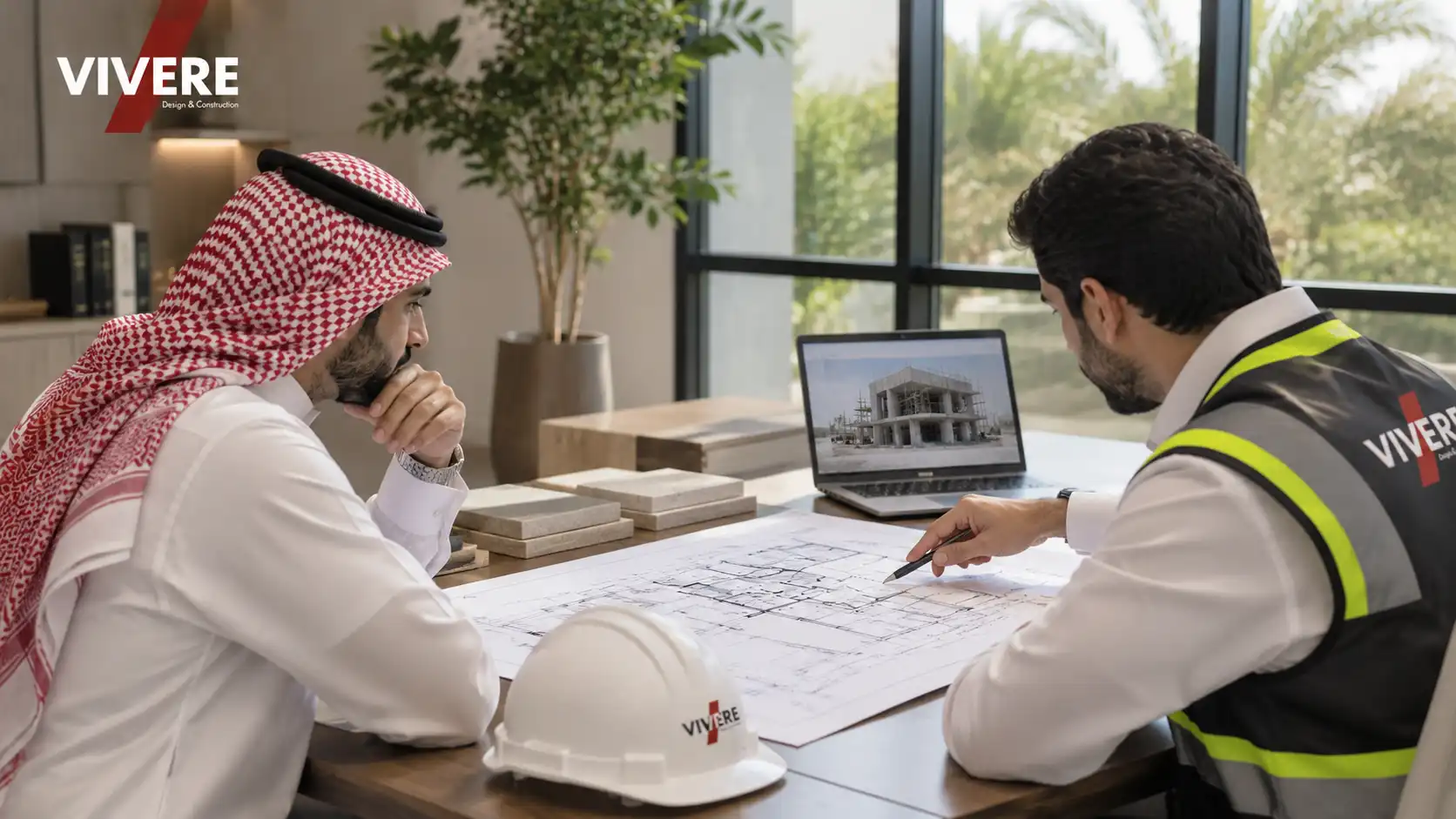
When a property owner decides to build a villa in Jeddah, their responsibility does not end with selecting a contractor and starting construction. Monitoring workmanship and verifying compliance with approved drawings and specifications require specialized engineering expertise. This makes choosing the right engineering supervision office an important decision throughout the construction process.
But how can you tell whether an engineering office is genuinely qualified to supervise your project? Is having a valid license and a portfolio of previous projects enough, or should you also evaluate the experience of the engineer who will visit the site, the number of visits, reporting procedures, and the limits of the office's responsibilities?
In this guide, we explore 8 practical criteria for choosing an engineering supervision office in Jeddah, along with the questions you should ask before signing an agreement and the warning signs to look out for.
Why Is Choosing the Right Engineering Supervision Office Important?
An engineering supervisor represents the owner's technical monitoring function on site, within the responsibilities defined in the agreement.
As a property owner, you may not be able to monitor every detail of excavation, foundations, reinforcement, concrete works, waterproofing, building services, and finishing. Even when you visit the site regularly, you may need specialized engineering expertise to determine whether the work complies with approved drawings and technical specifications.
Choosing an unqualified office or one with poor supervision procedures may result in inadequate monitoring or delayed identification of technical issues, particularly in construction activities that become concealed by subsequent work.
For this reason, your decision should not depend on price or company reputation alone. You should evaluate the office's ability to provide documented technical supervision with clearly defined responsibilities.
1. Verify the Office's License and Scope of Practice
Start by confirming that the engineering office holds the appropriate license to practice its engineering activities and that its approved scope includes the supervision services required for your project.
Do not assume that every business described as an "engineering office" automatically provides engineering supervision. Permitted activities and specializations may differ between offices.
Ask to review the following:
- The engineering office's license and its validity.
- The engineering activities the office is authorized to provide.
- The details of the engineer responsible for supervision.
- The engineer's professional registration and accreditation with the Saudi Council of Engineers, according to applicable requirements.
- The engineering disciplines available to support your project.
It is also important to identify who will actually be responsible for your project. Hiring a licensed engineering office does not necessarily mean that the person visiting your site has the right experience for your specific construction activities.
You can refer to the Saudi Council of Engineers for information related to engineering offices and professional practice.
2. Ask About the Office's Experience Supervising Villas in Jeddah
General engineering experience is not always enough. It is preferable to choose an office with experience supervising projects similar to yours in terms of building type, construction scope, and execution stages.
When evaluating an office's experience in Jeddah, consider its ability to monitor details that may significantly affect the project, including:
- Excavation and foundation works in accordance with the geotechnical investigation report.
- Reinforcement inspections and concrete works.
- Waterproofing and thermal insulation.
- Coordination of electrical and mechanical installations.
- Finishing works and material selection.
- Identifying and addressing technical observations during construction.
Request examples of previous projects and ask about the office's actual role in each one. Was it responsible for site supervision, architectural or structural design only, or project management?
Do not rely solely on statements such as "We have extensive experience." Try to understand the types of projects the office has supervised, the construction stages it monitored, and the deliverables it provided to the owner.
3. Check the Office's Independence and Potential Conflicts of Interest
This is one of the most important considerations when choosing an engineering supervision provider.
The contractor is responsible for executing the work, while the supervising engineer monitors construction and verifies its technical compliance with approved drawings and specifications.
For this reason, many property owners prefer their supervising engineering office to be independent of the contractor. This helps the supervising party report technical observations without a conflict with the interests of the construction company.
Before signing, ask the office directly:
- Do you have any commercial relationship or partnership with the contractor?
- Do you have financial arrangements or commissions with suppliers or contractors?
- To whom are technical observations reported when non-compliant work is identified?
- How are observations and corrective actions documented?
If the same company provides both construction and supervision services, it is important to understand how execution and monitoring responsibilities are separated, how observations are documented and addressed, and who reviews and verifies the supervision results on behalf of the owner.
The goal is not simply to have an independent party. It is to ensure that clear and transparent procedures are in place to protect the owner's interests through technical monitoring.
4. Request a Written Scope of Work Before Signing
The term "engineering supervision" can mean different services to different firms. Therefore, do not rely on a general description in a price quotation. Request a written scope that clearly defines the supervision activities, deliverables, and responsibilities.
Depending on the agreement, the scope may include:
- Reviewing drawings and specifications before construction begins.
- Monitoring excavation and site preparation.
- Inspecting foundations and reinforcement before concrete pouring.
- Monitoring structural works.
- Following up on waterproofing and thermal insulation.
- Inspecting electrical and plumbing installations before they are covered.
- Monitoring finishing works and materials.
- Documenting technical observations and following up on corrective actions.
- Reviewing contractor payment applications, if included in the scope.
- Participating in preliminary and final handover inspections.
You should also confirm which services are excluded, such as laboratory testing, preparation of new drawings, additional design work, project management, and additional site visits.
The clearer the scope of work, the easier it becomes to evaluate the service and compare proposals from different engineering offices.
5. Ask About Site Visits and the Engineer Responsible for Your Project
One of the most important questions before signing is: How many site visits are included, and who will actually be responsible for monitoring the project?
Supervision arrangements vary according to project requirements. Some offices rely on scheduled periodic visits, while others provide a resident engineer based on agreed working hours and attendance arrangements.
A lower number of visits does not necessarily mean poor service, just as frequent visits alone do not guarantee good supervision. What matters is the timing of each visit and the construction activities being inspected.
Ask about the following:
- How many site visits are included per week or month?
- Are visits scheduled according to construction stages or a fixed timetable?
- Which engineer will actually visit the site?
- Will engineers from other disciplines be required at certain stages?
- What is the procedure for requesting additional visits?
- Does the agreement include periodic visits or a resident engineer?
The contract should also define how activities that must be inspected before they are covered will be handled. These may include foundation and slab reinforcement, electrical and plumbing installations, and waterproofing works.
There should be a clear procedure for notifying the supervisor before these activities take place, together with an agreed timeframe for site attendance and inspection before work proceeds to the next stage.
To understand supervision arrangements and fee structures in more detail, read our guide: Villa Construction Supervision Cost in Jeddah.
6. Evaluate the Quality of Reports and Documentation
Supervision activities that are not properly documented can be difficult for the owner to evaluate or refer to if a disagreement arises.
Therefore, do not simply ask whether the office provides periodic reports. Request a sample report from a previous project, with any private client or project information removed.
A useful supervision report may include:
- The inspection date and construction stage.
- The work activities inspected.
- Clear photographs of the site and inspected activities.
- Descriptions and locations of technical observations.
- Required corrective actions.
- The party responsible for addressing each observation.
- The status of each observation, whether open or resolved.
- Engineer recommendations before proceeding to the next stage, where necessary.
Ask how frequently reports are issued, how they are delivered, and whether the office maintains organized records of site visits, observations, and corrective actions.
These documents help the owner monitor the project, understand what is happening on site, and refer to previous findings when needed.
7. Compare Technical and Financial Proposals, Not Just Prices
When you receive proposals from different engineering supervision offices, do not start by comparing the total fees alone.
One office may submit a lower quotation because it includes fewer site visits, a narrower scope of work, or fewer services than another provider.
Try to compare proposals on a consistent basis by reviewing:
- The scope of services and construction stages covered.
- The number and nature of site visits.
- The experience of the supervising engineer and team.
- The type of reports and how frequently they are issued.
- Inspection procedures before work is covered.
- Coordination of testing and review of material test results.
- Review of payment applications and handover inspections, if included.
- Excluded services and additional charges.
- Contract duration and extension arrangements.
A higher-priced proposal may be more suitable for your project if it provides broader services and more comprehensive follow-up. On the other hand, a lower-priced proposal may be appropriate when your project's supervision requirements are limited and clearly defined.
The most important thing is to understand exactly what you are receiving in return for the agreed fees.
8. Review the Engineering Supervision Contract Carefully
After selecting a suitable office, the next step is reviewing the contract. Do not rely only on verbal agreements or a short quotation. Make sure the agreement clearly defines the services and obligations of both parties.
Before signing, check that the contract covers:
- The supervision scope and included and excluded activities.
- The office's details and the engineer responsible for the project.
- The number of visits and level of site presence.
- The contract duration and its commencement and completion dates.
- Supervision fees and payment arrangements.
- Procedures for calculating additional visits and services.
- The office's reporting and documentation obligations.
- Procedures for recording technical observations and following up on them.
- The responsibilities of the office, property owner, and contractor.
- Arrangements for construction delays or supervision extensions.
- Contract termination procedures and settlement of outstanding obligations.
It is also important to understand that a supervision contract does not automatically authorize the engineering office to amend the contractor's agreement or issue financial instructions on behalf of the owner. These powers should be clearly defined in writing.
Warning Signs to Look Out for Before Signing
In addition to the criteria above, certain warning signs should prompt you to review a proposal more carefully before making a decision:
- The office is unwilling to provide its license or the supervising engineer's details.
- It cannot provide examples of previous projects or supervision reports.
- It offers an unusually low price with an unclear scope of work.
- It does not identify the engineer who will actually visit the site.
- It fails to specify the number of visits or construction stages covered.
- It has an undisclosed relationship with the contractor or suppliers.
- It has no documented procedure for handling technical observations.
- It pressures the owner to sign before explaining the contract terms and excluded services.
The presence of one of these signs does not automatically mean that an office is unqualified. However, it is a valid reason to request written clarification before signing.
Frequently Asked Questions About Choosing an Engineering Supervision Office in Jeddah
How do I choose the right engineering supervision office for my villa?
Start by verifying the office's license and scope of practice. Then review its experience with similar villa projects, ask about the supervising engineer, and check the number of site visits, reporting procedures, and contractual scope. Compare proposals based on the actual services provided rather than price alone.
Should the engineering supervision office be independent of the contractor?
Many property owners prefer an independent supervising office to reduce potential conflicts of interest. If there is an existing relationship between the two parties, it should be disclosed in advance, and the procedures for separating execution and monitoring responsibilities must be clearly defined.
Can the same engineering office that designed my villa also supervise its construction?
Yes. An engineering office that prepared the design may also provide supervision services if it is licensed for the required activity and has the appropriate team and experience. Its familiarity with the project may help it follow up on design details, provided that the supervision scope and responsibilities are clearly defined in the agreement.
How many site visits are required for villa construction supervision?
There is no fixed number suitable for every project. The required visits depend on the villa's size, complexity, construction duration, and the activities that require inspection. What matters is ensuring that the inspection schedule covers key construction stages, particularly activities that will later be concealed.
Are photographic supervision reports sufficient to monitor a construction project?
Photographs are an important part of documentation, but they are not sufficient on their own. Reports should also describe the inspected activities, technical observations, required corrective actions, responsible parties, and the status of each observation.
What is the difference between periodic supervision and a resident engineer?
Periodic supervision involves scheduled site visits or inspections at specific construction stages. A resident engineer, on the other hand, is present at the site according to working hours and attendance arrangements defined in the contract. The appropriate option depends on project size, complexity, and the required level of monitoring.
Does an engineering supervision office guarantee that no defects will occur in the villa?
No. An engineering supervision office cannot guarantee that every construction defect or problem will be prevented. However, organized technical supervision helps verify compliance with approved drawings and specifications, identify observations at appropriate stages, and document corrective actions within the agreed scope of service.
When should I hire an engineering supervision office?
It is preferable to select and contract with the supervision office before construction begins. This allows the office to review drawings and specifications, understand the project requirements, and establish a site visit schedule and inspection points before work starts.
Conclusion
Choosing an engineering supervision office in Jeddah should not depend on price or the number of previous projects alone. A good decision starts with verifying the office's license and experience, identifying the engineer who will monitor the site, and ensuring that supervision responsibilities, site visits, reports, and contractual terms are clearly defined.
The clearer the office's responsibilities and monitoring procedures are from the beginning, the easier it becomes to follow construction quality, understand technical observations, and monitor their resolution throughout the building process.
If you are planning to build a villa in Jeddah and need engineering services suited to your project requirements, contact the Vivere team to discuss your needs and explore the available architectural design, engineering supervision, and coordination services.